

How Passive UHF RFID Tags Work: Power, Backscatter, and Energy Flow


Passive UHF RFID is a form of automatic identification technology widely used in modern business operations, particularly in environments that demand speed, accuracy, and efficiency in reading large numbers of items. This technology is commonly applied in inventory, distribution, retail, asset tracking, and various other workflows that require more consistent data visibility than manual identification methods.
Behind these capabilities, Passive UHF RFID works based on a specific physical mechanism. This system involves more than just the process of reading the identity. tag, but also includes the transfer of energy from the reader to the tag, battery-free tag activation, and sending a response to the reader via modulated signal reflection. Therefore, the discussion regarding Power, Backscatter, And Energy Flow is the core to understand how Passive UHF RFID works more precisely.

Passive UHF RFID
Passive UHF RFID is a radio wave-based identification technology in the infrared spectrum.Ultra High Frequency (UHF), in Indonesia UHF RFID generally works in the range 920–925 MHz, using tags without internal batteries. Unlike active RFID, passive tags don't have their own power source to power the chip or actively transmit signals.
In operation, passive tags can only work when they are in the reader's beam area. Reader By sending out RF energy, the tag receives some of that energy and then uses it to activate its internal chip and generate a response. This characteristic makes Passive UHF RFID relevant for businesses with high read volumes and greater automation requirements.
Position of Passive UHF RFID in the RFID Family
To understand the context of Passive UHF RFID, it is important to look at its position within the general RFID technology family. The differences between RFID types not only lies in the operating frequency, but also in the way the tag obtains energy, the reading distance, and the type of application for which it is most suitable.
Active dan Passive RFID Tag
In general, RFID tags are divided into active tag And passive tag Active tags have an internal battery so they can support communication functions with a wider range and are typically used in high-value asset tracking scenarios or areas that require a longer read range.Far. However, the weakness of active tags is that the battery also has a limited lifespan.
In contrast, passive tags don't have an internal battery and rely entirely on energy from the reader. Because they're simpler, thinner, and more economical, passive tags are more widely used for labeling large quantities of items, such as cartons, pallets, retail products, documents, and operational assets.
LF, HF, and UHF
RFID technology is also differentiated based on its working frequency, namely LF, HF, And UHF. LF and HFgenerally used for applications with short read distances and certain environmental characteristics. HF, including NFC, widely used for access cards, payments, and other short-range applications.
UHF RFID occupies the most relevant position for mass identification needs in business environments. Compared to LF and HF, UHFmore suitable for operational flows such as warehousing, distribution, retail, and asset tracking. Because offers the ability to read more tags in a short time, supports longer reading distances.

Three Key Concepts of How Passive UHF RFID Works
The way Passive UHF RFID works is basically based on three main concepts, namely Power, Backscatter, And Energy Flow These three concepts do not stand alone, but rather form a series of processes that explain how passive tags can be activated and how data can finally be received by the reader.
Understanding these three concepts is important because the performance of Passive UHF RFID is not only determined by the presence of the reader and tag, but also by the quality of energy transfer, the stability of energy flow in the system, and the ability of the tag to form a signal response that can be read well.
1. Power
Power refers to the RF energy emitted by the reader and received by the passive tag. Since passive tags don't have batteries, this energy is the primary power source for activating the internal chip and initiating communication.
2. Backscatter
Backscatter This is how a passive tag works to send data back to the reader by utilizing the reflected signal from the reader itself. The passive tag converts the reflected signal pattern into information that the reader then captures and converts into digital data.
3. Energy Flow
Energy Flow explains how energy moves throughout the entire Passive UHF RFID process, from the reader to the tag, used to activate the chip, and then supporting the formation of a response that is received back by the reader. This concept shows that tag reading in Passive UHF RFID is essentially a sequential process of energy transfer and signal processing.
The Relationship Between Power, Backscatter, and Energy Flow
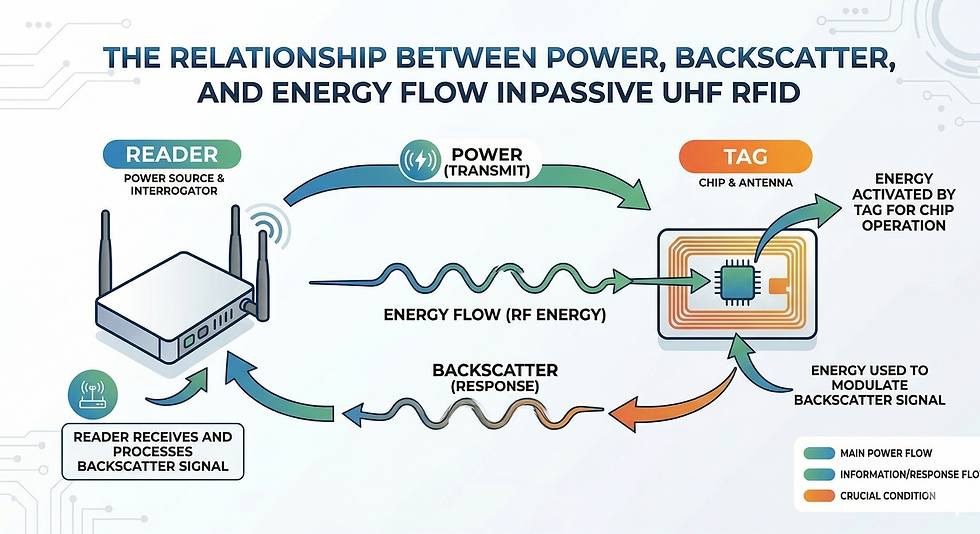
In Passive UHF RFID, Power, Backscatter, And Energy Flowmust be understood as interconnected elements. The reader doesn't simply send a signal to be read; it first provides energy. This energy then travels and is utilized by the tag, before finally enabling the tag to generate a response through backscatter.
If any of these three elements is not functioning optimally, tag reading performance will decrease. If the received energy is too low, the tag chip will not activate. If the energy flow is disrupted by environmental conditions, the tag will not function stably. If the backscatter response is too weak or unclear, the reader cannot consistently identify the tag.
Power pada Passive UHF RFID
Draft Power It is the foundation upon which all passive UHF RFID mechanisms operate. Without sufficient energy from the reader, a passive tag cannot activate its internal circuitry. Therefore, discussing power is always the starting point in understanding how passive tags can operate without batteries.
Reader as a Power Source
In Passive UHF RFID, the reader acts as a source energy external to the tag. The reader emits RF energy to the reading area via antenna, and this emission is the basis for passive tag activation.
In this context, the reader functions not only as a reading device but also as a temporary power source. The entire identification process for a passive tag begins with the energy the reader sends into the surrounding environment.
Power Reception by Tag
When a passive tag is in the reading area, the tag's antenna captures some of the energy emitted by the reader. This energy is then transmitted to an internal chip and converted into a small amount of electrical power, but enough to activate the tag's circuitry.
Power reception effectiveness is greatly influenced by various factors, including the distance between the tag and the reader, tag orientation, antenna position, and the characteristics of the object on which the tag is mounted. Therefore, the power availability to the tag is not always the same in every implementation scenario.
The Effect of Power on Reading Performance
The quality of power transfer is crucial for determining whether a passive tag can activate consistently. The more efficiently the tag receives energy, the more likely it is to produce a stable response.
Energy Flow pada Passive UHF RFID
After understanding that power comes from the reader, the next step is to see how that energy moves throughout the process. This is where the concept of Energy Flow becomes important, because this concept explains the flow of energy from the start of the emission to the formation of the tag response.
Energy flow shows that reading Passive UHF RFID is not just a data exchange process, but an energy transfer process that must be stable enough for communication to occur properly.
Energy Flow from Reader to Reading Area
The energy flow process begins when the reader emits energy. RF to the reading area. The energy spreads following the antenna's radiation pattern and forms a zone where the tag can receive energy to activate.
In practice, energy distribution isn't always even. Antenna radiation patterns, area layout, and the presence of objects around the reader can affect how energy is distributed across the field.
Energy Flow from Reading Area to Tag
When the tag enters an area with sufficient RF energy, the tag's antenna captures the energy and channels it to the chip. At this point, energy flow shifts from the external RF space to the tag's internal circuitry.
Because the energy received by passive tags is relatively limited, efficient tag design is crucial. Tags must be able to utilize this small amount of energy effectively to remain active and respond to readers.
Energy Flow in the Response Process
Energy flow doesn't stop when the tag is active. The energy received by the tag also forms the basis for the tag to generate a signal response that will be received back by the reader.
Thus, energy flow is a bridge that connects the activation stage with the communication stage. Without sufficient and stable energy flow, the process Passive UHF RFID reading will not take place effectively.
Backscatter pada Passive UHF RFID
Once the passive tag has acquired power and the energy flow is operating properly, the next step is generating the tag's response. In Passive UHF RFID, this process is not carried out through active transmission, but rather through a mechanism.backscatter.
Backscatter is the core communication principle that distinguishes passive tags from active radio devices. Through backscatter, tags can still transmit their identity without the need for batteries or an active transmitter.
Basic Principles of Backscatter
Backscatter is a mechanism by which a passive tag reflects a signal back from a reader in a specific pattern. The tag doesn't generate a new signal on its own, but instead alters the characteristics of the reader's signal reflection.
This change in reflection characteristics is then detected by the reader as digital data. In other words, communication in Passive UHF RFID occurs through modification of the reflected signal, not through a new, stand-alone transmission.
The Role of Chips in Backscatter
A chip in the tag regulates the antenna's impedance changes very rapidly. This change affects how the reader's signal is reflected by the tag, creating a pattern that the reader can recognize as information.
Backscatter Dependence on Power and Energy Flow
Backscatter can only occur if the tag first receives sufficient power and the energy flow is smooth. If the received energy is too low, the chip will not be able to modulate the reflected signal stably.
The better the power is received and managed by the tag, the better the chance that the backscatter response can be read by the reader.
Implications for Business Implementation
Understanding of relationships Power, Backscatter, And Energy Flow have important practical value in RFID implementations in business environments. These three concepts help explain why system performance can vary between use cases, even though the devices used appear similar.
By understanding the basic mechanisms, businesses can assess that the success of Passive UHF RFID implementation does not only depend on device hardware, but also on the quality of the reading area design, the characteristics of the object, and the actual operational conditions in the field.
Tag Reading Sensitivity
One of the most common challenges that arise in RFID projects is the sensitivity of tag reading. In one scenario, the tags can be read very well, while in another scenario the results are less stable.
These conditions are often related to suboptimal power supply, disrupted energy flow, or backscatter that is too weak to be read consistently. Therefore, performance variations should be understood as a consequence of the physical conditions of the implementation, not solely a hardware issue.
Implementation Planning
Understanding these three core concepts helps businesses plan scalable implementations. Reader position, tag orientation, object type, and read area layout all need to be evaluated based on how energy will travel and how the tag will respond.
This approach is important so that implementation does not stop at procuring devices, but is truly in accordance with the system design and operational needs.
System Performance Expectations
Passive UHF RFID is often perceived as a technology that can instantly read all tags. In practice, reading results are heavily influenced by the relationship between power, energy flow, and backscatter in real-world environments.
Therefore, a technical understanding at the business level will help form more accurate expectations about system performance. This is crucial for closing the gap between implementation expectations and actual results in the field.
Challenges in Energy Transfer and Tag Response
While Passive UHF RFID is highly effective for many applications, it can be affected by certain environmental conditions. These factors need to be considered because they significantly impact reading stability.
In many cases, RFID implementation challenges do not arise from understanding the basic concept is wrong, but rather because the operational environment affects how energy is transferred and how signals are reflected back.
Liquid Influence
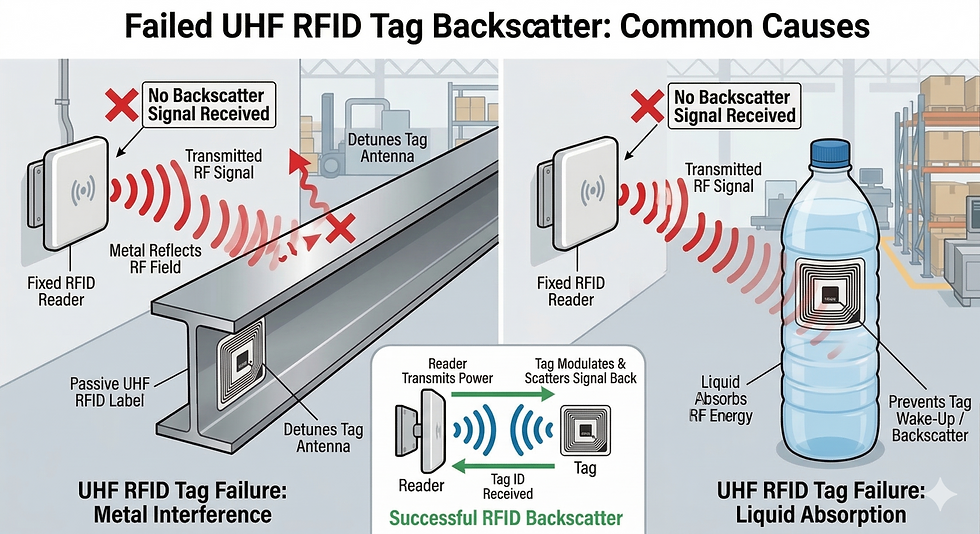
Liquid materials tend to absorb some RF energy at UHF frequencies. This can weaken the power received by the tag and reduce energy flow.
As a result, tags on bottles, liquid pharmaceutical products, or other liquid-based items tend to be more challenging to read than non-liquid objects.
Metal Influence
Metal surfaces can significantly reflect RF energy waves and alter the field conditions around the tag. In a UHF RFID reading environment, excessive reflection from metal can cause interference or multipath, which often disrupts the way the tag receives power and produces a stable backscatter response.
Therefore, metal objects usually require a special approach, both in terms of the type of tag (on-metal tag) and implementation design, to ensure effective reading.
The Influence of Layout and Orientation
In addition to environmental characteristics, the orientation and layout of the reading area are often crucial factors affecting energy flow quality. This means that even if the RFID device is properly installed, reading results can still be drastically reduced if the layout design does not reflect actual field conditions.
Therefore, Passive UHF RFID must be tested under actual operational conditions before being widely implemented, to ensure optimal implementation.
Conclusion
Passive UHF RFID works based on a close relationship between Power, Energy Flow, And Backscatter The reader transmits RF energy as power, the tag receives and uses that energy to activate the chip, and the tag then generates a response through a reflected signal that can be read back by the reader. Thus, passive tag reading is essentially the result of a series of energy transfers and signal processing that occur sequentially.
For businesses, understanding these three core concepts is crucial because RFID performance is determined not only by the type of device used, but also by the quality of the implementation design and the characteristics of the operational environment. The better the understanding of the relationship between these three, the more informed decisions can be made in designing an RFID system that is stable, accurate, and meets the needs of business processes.
As an end-to-end RFID solutions provider, TUDI can help companies in designing more targeted implementations, starting from identifying use cases, field testing, to integration into operational systems. Consult your RFID implementation needs with a team of experts from TUDI to get a tested and optimal solution in the field.


