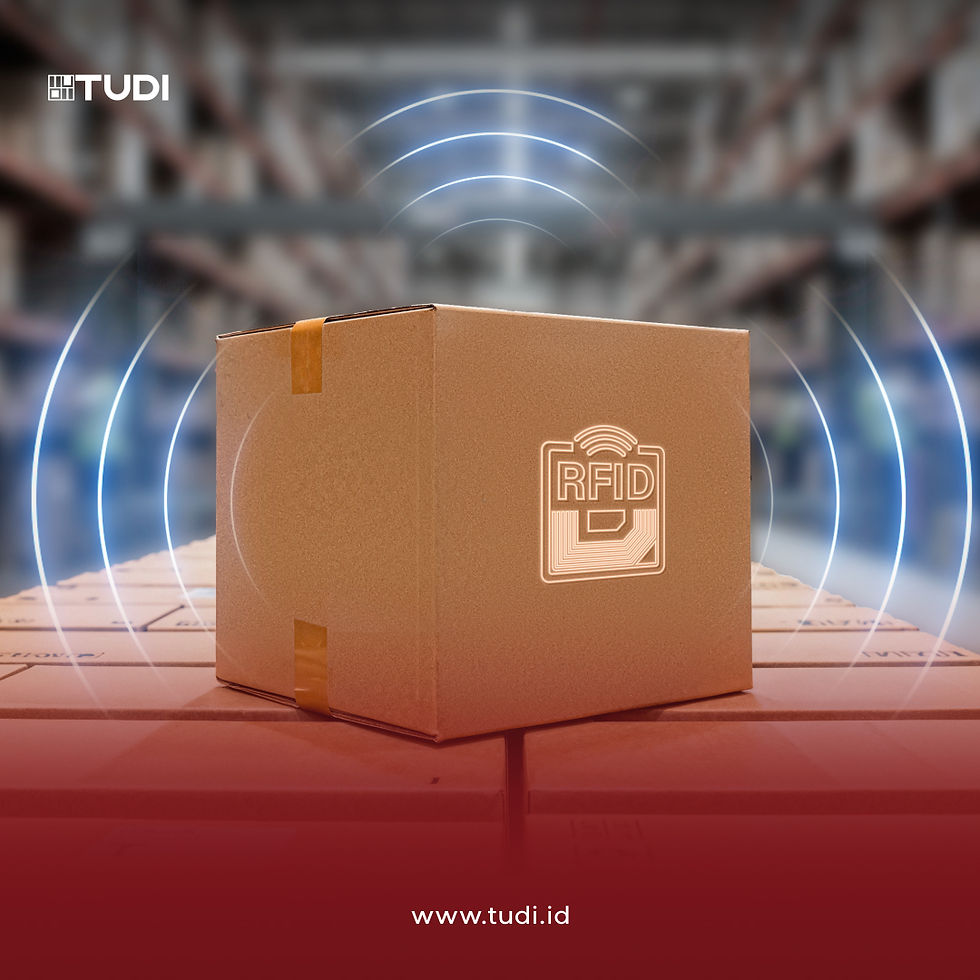
How RFID Works: Explanation, Function, Components, and Types


In the era of industrial automation and digitalization, data speed and accuracy are key factors in maintaining operational efficiency. Many companies are starting to abandon manual identification methods because they are no longer able to keep up with the complexity of modern business processes. This is where RFID technology plays an important role as a reliable, flexible, and easily integrated automatic identification solution. To understand its potential optimal application, it is important to know how RFID works, especially based on the type of frequency used.
Explanation of RFID Technology
RFID (Radio Frequency Identification) is an automatic identification technology that utilizes radio waves to read and store data on a medium called a tag RFID. Each tag has a unique identity that can be read by a reader without requiring physical contact or a direct line of sight. The information read is then processed by a system to support various operational needs, from asset tracking to inventory management.
In contrast to barcodes which require scanning one by one, RFID allows fast and simultaneous data reading. This characteristic makes RFID highly relevant for industrial environments with high volume and dynamic movement of goods.
Functions
RFID technology has a strategic role in supporting the automation and visibility of business processes.
1. Automatic Asset Tracking
RFID allows each asset to be given a unique identity so that its movement and status can be monitored in real time. This helps reduce asset loss and improves data accuracy.
2. Fast Inventory
With the ability to read many tags at once, stock count processes can be done much faster than manual methods or barcodes.
3. Operational Process Automation
RFID supports automation in receiving, shipping, and production processes, thereby reducing dependence on manual input and minimizing human error.
4. Increased Security and Traceability
The unique identity on each tag helps ensure product authenticity and provides a movement trail of goods from the beginning to the end of the process.
Components
An RFID system consists of several main components that work in an integrated manner.
1. RFID Tag
Functions as a medium for storing data and object identity. Tags are available in various forms and specifications according to application needs.
2. RFID Reader
Plays a role in reading and processing data from RFID tags via radio waves.
3. Antenna
Used to transmit and receive signals between the reader and the tag. The design and placement of the antenna greatly affect reading performance.
4. Software
Manages the data resulting from RFID reading and integrates it with business systems such as WMS or ERP.
How RFID Works Based on Frequency Type
The way RFID works is greatly influenced by the frequency used. Each type of frequency has different communication mechanism characteristics.
1. LF (Low Frequency)
In LF RFID, the system's operation relies on a very short distance between the tag and the reader. The reader generates a magnetic field around it, and when the tag is in that area, the energy from the magnetic field will activate the chip inside the tag. Once active, the tag sends its identity data back to the reader.
Because of the limited read range and relatively low data transfer speed, LF RFID is not used for mass reading. However, this technology is known to be stable and not easily disturbed by water or the human body. Therefore, LF is often used for animal identification, simple security systems, and applications that demand reliability at close range.
2. HF / NFC (High Frequency)
In HF RFID or NFC, the operation still relies on proximity between the tag and the reader, but with better data exchange efficiency. When the tag is brought close, the reader and tag form a connection that allows data to be exchanged quickly and consistently.
This characteristic makes HF RFID very suitable for direct interaction-based applications, such as access cards, contactless payments, transportation tickets, and document labeling. The limited read range actually provides better control over the identification process and data security.
3. UHF (Ultra High Frequency)
In UHF RFID, the system's operation allows reading from a farther distance and in large quantities. The reader transmits radio waves to a certain area, and the RFID tags within range capture that energy to activate the chip. After that, the tag reflects the signal carrying its identity information back to the reader.
The main advantage of UHF RFID is its ability to read many tags simultaneously over a distance of several meters. This makes it very effective for warehouse, logistics, and manufacturing environments, where speed and efficiency are a priority. With the right antenna design and selection of a tag that suits the object's condition, the UHF RFID system is capable of providing fast, accurate, and consistent reading results in daily operations.

Advantages
RFID technology offers various advantages in increasing operational efficiency.
1. No Direct Contact Required
Data reading can be done without touching or precisely pointing a scanner at the object.
2. High Speed and Accuracy
RFID is capable of reading many items at once with a very low error rate.
3. Flexible and Scalable
The RFID system can be adjusted to the scale of the business and easily developed along with operational growth.
Disadvantages
Despite having many advantages, there are several things that need to be considered in its implementation.
1. Environmental Influence
Materials such as metal and liquids can affect reading performance, especially on UHF, requiring proper technical planning.
2. Initial Investment
RFID implementation requires an initial investment for devices, system integration, and work process adjustments.
3. Data Management
Good security and data management policies are needed so that the information generated remains protected.
Applications in Various Industries
RFID technology is now used in various sectors due to its flexibility and efficiency.
1. Retail
Supports item-level stock tracking, shelf restocking, and reduction of merchandise loss.
2. Logistics
Speeds up receiving, shipping, and inventory processes in the warehouse.
3. Manufacturing
Helps track Work In Process (WIP) and increases production traceability.
4. Healthcare
Used for tracking medical devices, medicines, and hospital asset management.
5. Transportation
Supports contactless ticketing systems and transportation asset management.
6. Libraries
Simplifies collection circulation and book inventory processes.
Conclusion
RFID technology plays an important role in supporting digital transformation and industrial automation. With fast, accurate, and contactless identification capabilities, RFID helps companies improve process efficiency, data accuracy, and provide better operational visibility across various business lines.
Although RFID implementation requires technical planning and initial investment, the long-term benefits generated are very significant when this technology is implemented with the right strategy. Various sectors such as logistics, manufacturing, retail, and healthcare have proven that RFID is capable of accelerating processes, reducing errors, and increasing operational competitiveness.
As an end-to-end RFID solution provider, TUDI is ready to help you design and implement an efficient, integrated RFID technology system that suits your business needs, especially UHF-based solutions. Consult your needs with the TUDI expert team to find the best solution for your company's growth and competitiveness.