
Technology fundamentals
Bluetooth Low Energy
Bluetooth Low Energy (BLE) lets powered devices exchange information by radio in the 2.4 GHz band. In a basic advertising sequence, one device broadcasts a small message and another scans for it, then passes the received information to software.
This explanation follows BLE advertising and scanning, as used by a beacon and a receiving device. BLE also supports connections for further data exchange.
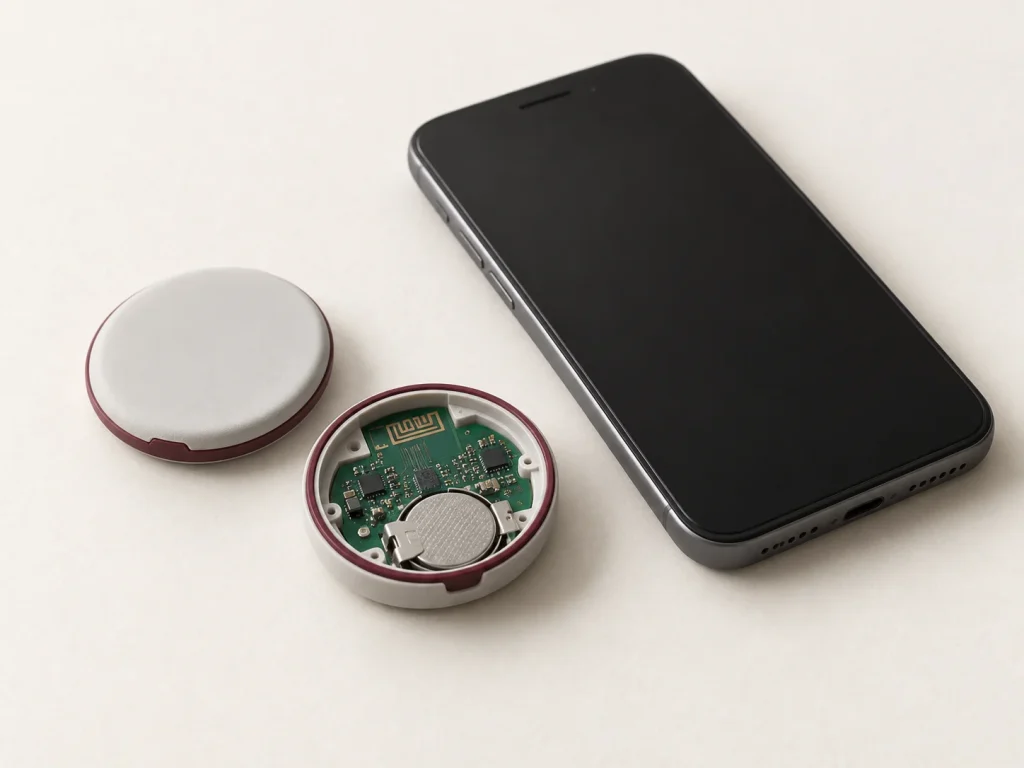

2.4 GHz radio
Main components.
Transmitting device
Uses a powered BLE radio and antenna to broadcast a prepared message.

Receiving device
Uses its own powered BLE radio and antenna to scan for incoming messages.
Application
Receives the message from the receiving device and interprets its content.
Advertising and scanning
How it works.
Advertising sends small packets of information over the 2.4 GHz radio band. Scanning listens for those packets. Both participating devices need power, which may come from a battery or another supply; the advertising signal does not power the receiving device.
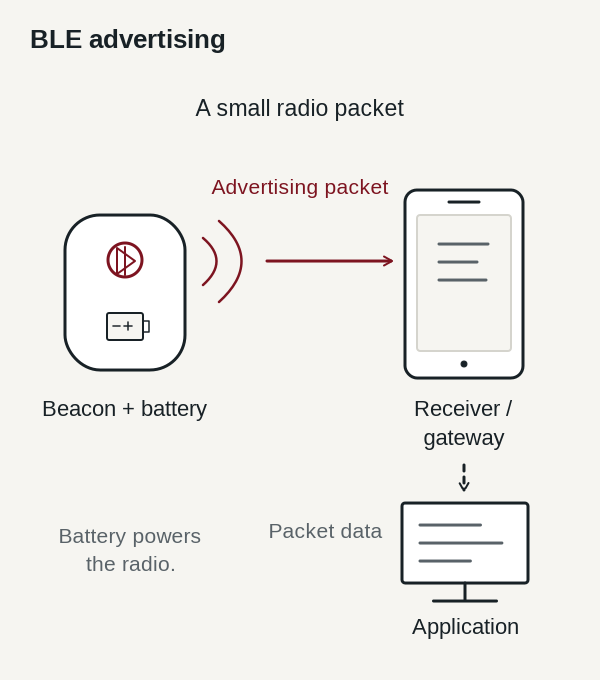
A message is prepared
The transmitting device prepares the information it will advertise. The message content depends on the device and its configuration.
The radio advertises
The device’s radio sends the message as an advertising packet. It can repeat this transmission at intervals.
Another device scans
A receiving radio listens for advertising packets. When it receives a packet, it processes the radio signal into information.
Software receives the message
The receiving device passes the message to an application. The application interprets the content according to the format it understands.
Received message
What information does it produce?
The immediate result is a received message. Its content could include an identifier, device status or sensor data supported by the device; these example values show one possible message, rather than fields every BLE device provides.
Example data
Identifier in the message: Beacon A-01
Status in the message: Ready
Software may associate the received identifier with a stored record. The receiver may also report received signal strength (RSSI), an observation of the received signal rather than data stored in the packet. An advertising packet is not inherently a set of position coordinates; any location interpretation needs additional information and processing.
Advertising and scanning do not require the devices to establish a connection. Where supported, devices can also create a BLE connection to exchange additional data; that is a separate communication sequence.